A political party is a group of individuals that have grouped together and believe in similar political ideology on the political spectrum. They, for the most part, hold semi-similar ideologies and tend to hang out with people in similar political parties. The role of a political party is to bring forward political policies that the party wants to pass to the attention of the everyday citizen. In modern politics, many people identify with some sort of political party, however, many people don't know the origin of the two-party system that the United States has adopted. The modern political parties that are present today originally looked a lot different with the ideologies being almost completely flipped during the Civil War with Democrats residing primarily in the south and were concerned about economic policies while Republicans resided primarily in the north and were focused on social policies. As shown in the map below, it shows how in 1960 the colors were completely flipped from what we are used to in the political map of today.
In modern America, with Trump pushing for more economic legislation, many people are asking if the Republican party is the better party to pass laws on economic policies. According to
GOP.com, Republicans are focused on reviving American jobs, tax reductions and encouraging American innovators. In contrast,
Democrats focus on higher taxes mainly on the rich, what is better for the whole is good for the individual, and investing in small businesses.
As the graph above shows, the Democratic party's economic policy is better for the average citizen while the Republican party's policy is only really good for big businesses and corporations. The chart shows that in the 44 years that a Democratic president has been in power, the average individual income has risen by 271% while in the 40 years that a Republican has been president the individual income has only risen by 44% on average.
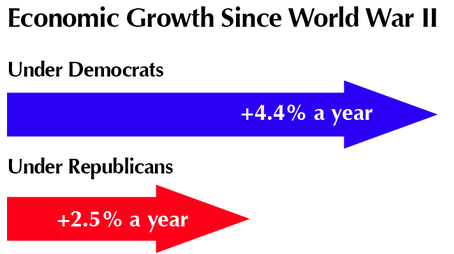
As the arrows above show, the economic growth has grown by an average of 4.4% a year under Democrats while under Republicans, the economy has only grown by 2.5% since World War 2. When tying these arrows to the graph above, we can infer that the individual income under Democrats also benefitted the top 10% as well as the rest of the country. Because of this, the Democratic party is better at creating a good economy based on the statics alone.